Tuesday, August 22, 2006

Places to Stick Signs

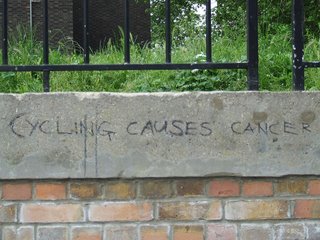
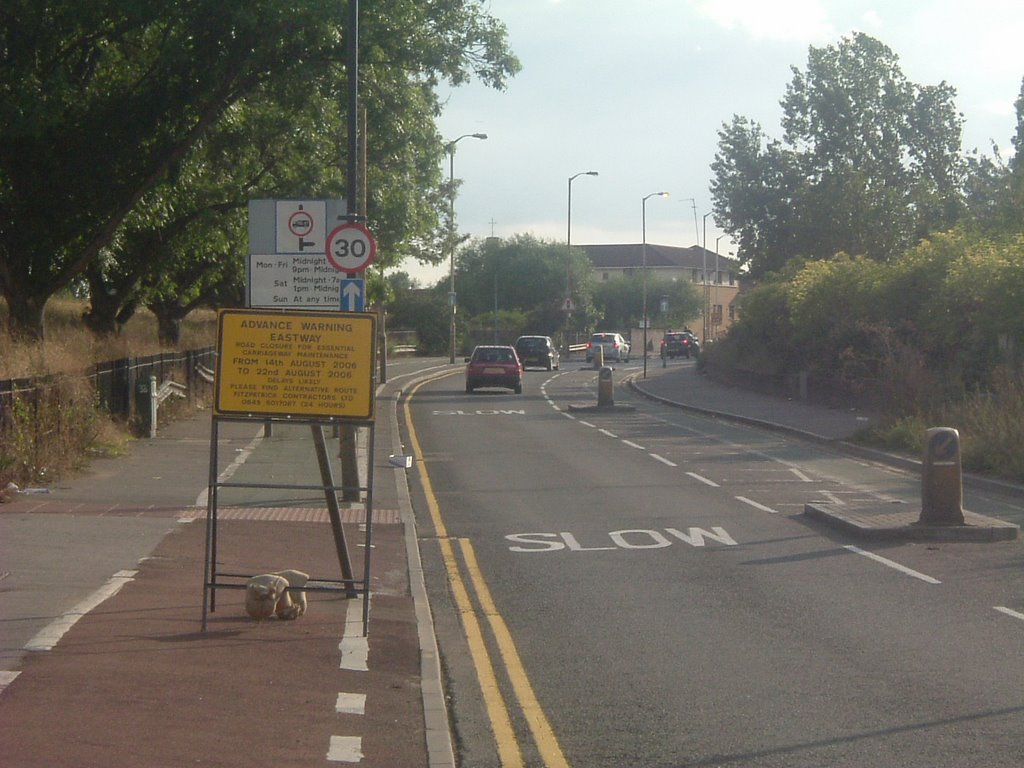
I can see it might be a bit of a problem for the Highways authorities. They need to stick a sign up, but haven't got room to put it. Can't put it on the road, it would inconvenience the motorists. Can't block the pavement - there'd be complaints. Ah! But there's always the cycle lane. No-one uses that do they? Especially the contra-flow ones that bypass busy roads in the City. The only people who will compain are cyclists, and everyone hates them anyway.


Monday, August 21, 2006

The Dials

I went and saw a band called the Dials a few weeks ago. They were supporting the Mekons who I'd liked back in the '80s. I think time has left the Mekons beind a bit. They helped to reabilitate country and folk back in the days when Elvis Costello risked an early end to his career by making a Country & Western album, and country generally was slated as cheesey, outdated, for old men. It was even before Johnny Cash was considered to be remotely cool. These days of course, country rules. At least it does if you're male and over about 25, under 45. Everyone now knows Johnny Cash is a great artist, cool, and about as rock'n'roll as you can be. We have bands like Wilco and Steve Earle who easily stand astride both the rock and country camps. Country elements form parts of many rock songs these days. It will leave most people wondering what's so special about the Mekons. They're a northern English band who play country quite badly, but with spirit. To be honest I was a bit surprised that their musicianship hadn't moved on at all, not an inch. Still, I'm glad I saw them.
S. didn't like The Mekons; she took a personal dislike to them after they nattered all the way through the support (The Dials) and gave her dirty looks when she complained. This ambivalence was reinforced when the band announced they were playing Urban75's Offline event in Brixton the following day, to an audience of trendy uptight tossers. Andy, who came with us, wasn't too impressed either. I had a history with the band, and even though I admit they weren't great - they never were technically - it was the spirit, the ragedness, and the fact that they were daring to take Indie where Indie, at first, really didn't want to go, and after it had gone, came back.
The Dials however, went down a storm. I thought they were excellent, and so did S. Mark Lamarr's been promoting them quite a bit lately, and there's a debut album in the pipeline. They're a Brighton band whose sound is very Tarantino-esque in places. I'd describe it as surfer country blues, jazzy too in places. They freely admit they steal from everywhere. My kind of band.
The Luminaire too was an experience - a very little venue, the smallest I've ever been to, probably slightly smaller than the cellar bar in Thames Polytechnic, where I sued to frequent back in the mid-80s.
I might buy the ep.

"Terror Plot" update

I just got this from the BBC. I'll be interested to read more.
 
"Eleven people have been charged in connection with an alleged terror plot to
blow up transatlantic airliners. More soon.

For more details: http://www.bbc.co.uk/news "

Music

This MP3 player is a feckin' godsend to me. It may be my AS, but I find it very difficult to make music decisions at times, ie, choosing what I want to listen to. The MP3 player takes the decision making out of my hands. I've got 200 odd fave tunes, and the rest is made up of new albums, classics, and downloaded stuff.
 
At the moment I've got a jazz section on there - loads of Count Basie early stuff, big band style - and plenty of old style, 30s jazz. And about a dozen tracks from John Coltrane.
 
I've also got Van Morrisson's 'Contractual Obligation' on there - very funny - and downloadable for free. Recommended.
 
Plus, Elvis Costello's Delivery Man, Wilco's double album, two CDs by Polyphonic Spree, the last Pulp CD, a soul section, a funk section, a reggae section, Viva Hate by Morrissey, about 50 alternative country tracks, and a whole Steve Earle album.
 
The only problem is the long winded method I have to use to put tracks on it. I don;t have much memory on my laptop so I have to rip each track first, and then move it into my player. Takes forever. I'm holding out for a bigger laptop so I can stick all my music on there.

The Real Terrorists

I was reading the Independent on Friday and checked up on the latest regarding 24 (now 23) arrested for an alleged bomb plot on August 9th / 10th (crap memory).
I was pretty sure that nothing would turn up in the investigation and that all 23 would be released without charge, or with very minor charges brought. Last week there were bulletins on the BBC that claimed that a "bomb making kit" had been found and martyr videos on computers.
Reading the articles in the Indie quite closely I discovered that both these bits of news came from "unconfirmed police source" and the story about the martyr video was "believed" to originate from American Intelligence source.
Sounds a bit vague to me. Sounds a bit like, its not true but we're gonna put it about in the press for a while, both to stoke up public fears, prop up this fictitious bomb plot for a while, secure court permission to hold these innocent young people for a bit longer.
I worry now that they're going to end up being extradited to America.
And then a story that was really depressing. A plane load of the scummiest English chavs - flying back on a Monarch airline plane, from malaga in Spain - decided they didn;t want two Indian blokes on the plane with them. They played up enough to get these two innocent men arrested. They were eventually released with no charge. I'd have arrested every motherfucking one of those English twats until the plane was fit to take off.
And I would have charged them! What with? I'd have found something. Hijacking a plane might have been a good one.
So who are the real terorrists? I'm reading "Trail of the Octopus" at the moment. This book tells the story of a DIA agent fleeing for his life to Sweden because of what he knew about Flight 103 which blew up over Lockerbie in 1988. It appears that our governments are so involved in running, supplying, training, and doing business with para-military groups in the Middle East that there is a very grey area dividing what we call "intelligence operations" and "terrorist operations". The other thing that has been highlighted for me is how much the intelligence organisations manipluate what appears in the press. How many journalists work for the DIA, CIA, MI5, MI6? How many newspaper owners work for these organisations? How many spook generated stories end up in our headlines? After Lockerbie, the US and UK managed to persuade the whole world to believe a politically convenient story they'd concocted completely at odds with the reality. No the press is joining in with framing 23 innocent muslims in the UK, and don;t forget the one in Pakistan who was arrested two days earlier. He's probably being tortured, and the UK doesn't seem particuarly keen to intevervene.

Friday, August 18, 2006

I'm too tired to think of a Title for this...

The week has just ended, i make it about 13 minutes past midnight, and the weekend is here. My work phone hasn't rung today so I assume that nothing went wrong. I'm exhausted. Last Friday S. kept me awake all night. Not what you might think, but I remember being really pissed off at 6 am and getting out of bed, drinking coffee, and falling asleep on the sofa to "Stoned" on DVD.
I took Tuesday off, but wasn't really capable of doing much. Slept in, went to pub and had breakfast - S. paid - went to laundrette. And then I took today off too. Got to the library, did a bit of shopping, watched "Sopranos" on DVD.
Haven;t had a drink for two days. I overdid it on Wednesday night when S stayed at my place. Ultimately I hope it improves my sleeping pattern, and causes me to lose weight. I might be able to save a little bit of cash too.
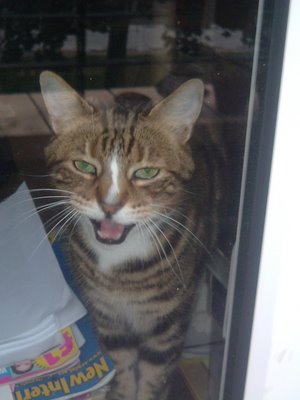
The cat's snoring beside me. He's been attention seeking all day, but finally ran out of energy.
Anyway - that's enough shit from me today.

Monday, August 14, 2006

floating bike

I saw this today. I wasn't surprised to see that an Indian man had come up with this extremely useful device. I could use it instead of the Woolwich Ferry, although I'm pretty sure it wouldn't save me any time. Or I could ride up the Lee Navigation on it. Still not sure it would help me much, although I still love the idea.


Ken's U-turn

First the good news:

"One week (and many complaints) after announcing his plans to force cyclists in London to have number plates, Ken Livingstone has shelved the idea. He agreed with CTC's concerns over the prohibitive cost of such a scheme and now wants to launch a 'Share the road' campaign which will encourage all road users to obey traffic regulations and advise them of the penalties for not doing so."

now the bizarre news

Cyclist fined for riding on the road
"A UK cyclist has been fined £100 with £200 costs for riding on the road and obstructing traffic. The Cyclists' Touring Club (CTC) reported that member Daniel Cadden was cycling fast downhill on a single-lane approach to a roundabout when he was stopped by police who believed that the position he had taken in the centre of his lane was forcing cars to cross the solid white line in the centre of the road illegally in order to overtake."

So who's breaking the law here then? Can I use as a defence that cars driving without due care and attention forced me to cycle illegally on the pavement? Probably not. I'm fucking appalled!

"CTC Director, Kevin Mayne, said, "The police at the scene said that Daniel
should have been cycling well over to the left - effectively in the gutter -
but the judge felt that Daniel should have crossed three lanes of busy
traffic and used a segregated cycle track to save fractions of seconds off
the journey times of a few motorists. CTC continues to fight a re-draft of
the Highway Code, which proposes cyclists 'should use cycle paths where
provided', in order to tackle the attitude, held by many people in the
judiciary, police and public alike, that cyclists should be out of the way
of motorists."

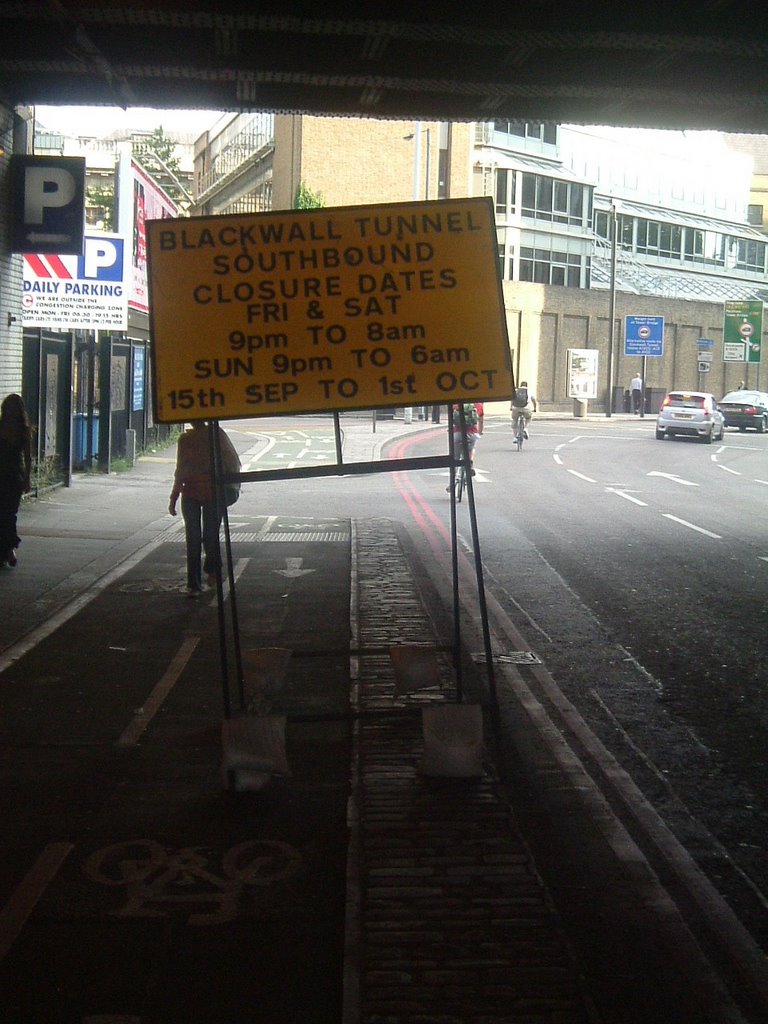
So it's true cyclists are about to be banned from using the roads we fucking pay for in our taxes. What makes it worse is that the cycling facilities we're expected to use are treated with such contempt by everyone else. I tried to use a contra-flow lane this morning, just north of Tower Bridge, and someone's put a fecking great sign warning of problems in the Blackwall Tunnel right across it. I had to cycle on the pedestrian bit.

Then at Leyton, there were about 20 lorries and other vehicle parked in the contra flow lane. I had to stop an on-coming lorry in order to make my way along the road. The driver didn't like it either.

I only hope that this cyclist can win on appeal.

terror raid - the list of those abducted by police:

British "Terror" Raids in august 2006

Those arrested:

Ahmed, Smith

Abdula Ahmed Ali

Cossor Ali

Shazad Khuram Ali

Nabeel Hussain

Tanvir Hussain

Umair Hussain

Umar Islam

Waseem Kayani

Assan Abdullah Khan

Waheed Arafat Khan

Osman Adam Khatib

Abdul Muneem Patel

Tayib Rauf

Muhammed Usman Saddique

Sarwar, Amjad

Assad Sarwar

Ibrahim Savant

Amin Asmin Tariq;

Shamin Mohammed Uddin

Waheed, Abdul

Waheed Zaman


These are the arrests that led to the ridiculous charade last week, that left thousands of people's holidays cocked up, and now 24 people arrested for being muslims.
I'd be surprised if any of these did anything remotely illegal - in the terrorism sense anyway. Although I'm sure the police could invent a few irrelevent charges for a few of them - "looking funny at a police officer" or "wearing muslim dress and attending a mosque
The original "intelligence" seems to have come from one of the British suspect'sbrother who was almost certainly tortured by police in Pakistan and forced to finger a load of innocent people he knew back in England.

Notepad Invaders

Wednesday, August 02, 2006

The Daily Mail Agrees With Ken's Bonkers Scheme

The fact that the Daily Mail agrees with Ken Livingstone shows how out of step with reality he really is.
At the moment I still see children cycling - that will end once this sceme is brought in. No more borrowing other people's bikes. It'll be an open door for police harrassment of cyclists. Even law abiding registered bikes may be stopped to show their papers.
Ken says that there'll be no change for law-abiding cyclists. Apart from 600 squid a year to regster my family's bikes. The stopping and searching we'll be subjected to to make this sceme work. The stupid and inappropriate, rather large number plate I'm going to have to rivet to my bike!!
What happens when people come from outside London to cycle? They're going to have to register their bikes beforehand. More likely, no-one will bother, and cycling in the capital will die out.
I'm going to sabotage the leg of the Tour De France in London next year - the leg that Ken was so supportive of - if this scheme is to go ahead. If I can't cycle I don't agree that Ken can have a high-profile event that seems to imply his support of cycling.
His cycling ads need to be subvertised too.

Tuesday, August 01, 2006

Mayor's Bonkers Cycle Scheme

I got this yesterday - regarding Ken Livingstone's frankly bonkers idea to register cyclists in London.

If you wish to write to express your views on compulsory registration you can do so by sending an email to: mayor@london.gov.uk <mailto:mayor@london.gov.uk>

LCC Press Release
Cycle registration could halt cycle growth in London*
An unworkable scheme to register cycles in London and fit them with
number plates could bring the welcome growth in London cycling to a
sharp halt
.
The scheme was proposed by Ken Livingstone, Mayor London. Speaking on the radio. Livingstone said he was considering a Private Bill in Parliament that would require registration of cycles and their owners, and for bikes to display a registration plate that could be monitored by cameras.
The London Cycling Campaign has written to Ken Livingstone expressing its dismay at the proposal which could undo efforts by the Mayor, Transport for London and organisations like the London Cycling Campaign to reduce congestion and pollution in the capital by promoting
sustainable transport.
Registration will be costly, complex and bureaucratic. It will also be a cost barrier for those considering taking up cycling, especially those on low incomes. Simon Brammer LCC?s director said ?There is no doubt that cycle licensing or registration in London would deter many
occasional cyclists and those who are considering taking up cycling. In particular it would have an impact on those who may be unable to afford the cost of a license. A better way to encourage safe and considerate cycling is cycle confidence training in line with National Standards.?
LCC has been pleased to see the capital benefiting from the recent increases in cycling. There is less traffic congestion, less pollution and less traffic noise as more people enjoy the health advantages of walking and cycling. Cycling training, not a costly licensing scheme, is the way forward.


From the Department of Transport
"The question of a registration and tax system for cyclists is often raised and the Department has examined this. We have concluded that it would be impossible since it would require a licensing similar to that for motorists. As there are in excess of 20 million bicycles in Great
Britain and many change hands through second hand sales, keeping track of this would be extremely difficult and expensive. The fee for any registration system could not be very large since it would need to relate to that payable for the smallest motor cycle - around £15.00 per
annum. We have therefore concluded that a registration scheme would be too expensive to establish and run since the costs of its administration would far outweigh the revenue received. It would also place an additional enforcement burden on the police. Moreover it would be difficult to impose a road tax on cyclists since they do not cause pollution and impose very little wear and tear on the roads particularly at a time when the Government is encouraging cycling?

*London Assembly** **Green Party Group*
news release
Friday, July 28, 2006
Bike registration ?impractical, costly and bureaucratic? says Mayor?s green adviser
Responding to the Mayor of London?s call for a bike registration scheme, Jenny Jones a Green Party member of the London Assembly said:
"If the London Mayor wants to stop the growth of cycling in London then a bike registration scheme will do it over-night. It is a completely impractical, costly and bureaucratic measure which will give the police a fairly pointless and thankless task, trying to chase bikes without
paperwork. We need to encourage casual cyclists to become regular cyclists by making it easier to cycle, rather than more difficult. We need more cycle training, rather than form filling. If we want cyclists off the pavement, then give them safer roads and more cycle lanes."
"I'm all in favour of changing the culture of both cycling and driving in London, which is why we got the Mayor to agree to a major campaign called 'Share the Road', which aims to promote mutual respect between all road users.?* *


The number of cycles owned in Britain is similar to the number of cars ? over 20million. So the cost of a registration scheme would be similar to that required for car licensing. To cover its costs, people would have to pay £150-£200 for every cycle owned, including children?s bikes. This would be a massive deterrent to people taking up cycling or going out just for the occasional bike ride. Yet these are exactly the people who we want to encourage to cycle more, if we are to tackle congestion, obesity, air pollution and climate change.

something funny's going on

that entry below was written and sent a week ago. It just arrived.

Scorchio!

It's fecking hot here. I'm pouring sweat just sitting at my desk. No air conditioning you see.
There's quite a lot of pressure coming with this project I'm working on at moment, so far from winding down in the heat, i'm working harder than ever before, and struggling.
Saw a band last night with a friend - a country band called The Hacienda Brothers. I met them afterwards, bought a CD from Hank, and got three of them to autograph the CD.
S. uploaded my Lambeth Country Show pictures from over a week ago. I cam away with all boxes on my wish list filled. I bought a Venus Flytrap for £7.50 - which is sitting in my kitchen window; a gallon of cider for £11 which I drank at the weekend; two obscure American books, one about native Americans, and another about girl gangs in movies.
Brockwell Park
I've restarted work on my book; picked up the 1946 to 1974 section to work on it. I reckon I've had some insights from that McNamara documentary which I saw over the weekend.
I've also started looking into the UK's secret service - I'm putting together a history and trying to keep an account of what is currently going on. Brown allies are systematically being smeared, sacked or forced to resign just as Blair is trying to wriggle out of his alledged promise to hand power over to his former political ally.
It'll be interesting if Blair manages to stay loyal to Israel now that its fairly obvious war crimes are being committed. If Blair does stay loyal - considering that he was manouvred into power by Zionist backers, it's quite likely he'll have little choice in the matter - then it should be the final nail in the coffin of Blair's political career.
We can all hope, anyway.

Monday, July 31, 2006

ZNet Update & Galeano Commentary

How Much Longer? by Eduardo Galeano
One country bombed two countries. Such impunity might astound were it not business as usual. In response to the few timid protests from the international community, Israel said mistakes were made.
How much longer will horrors be called mistakes?
This slaughter of civilians began with the kidnapping of a soldier.
How much longer will the kidnapping of an Israeli soldier be allowed to justify the kidnapping of Palestinian sovereignty?
How much longer will the kidnapping of two Israeli soldiers be allowed to justify the kidnapping of the entire nation of Lebanon?
For centuries the slaughter of Jews was the favorite sport of Europeans. Auschwitz was the natural culmination of an ancient river of terror, which had flowed across all of Europe.
How much longer will Palestinians and other Arabs be made to pay for crimes they didn't commit?
Hezbollah didn't exist when Israel razed Lebanon in earlier invasions.
How much longer will we continue to believe the story of this attacked attacker, which practices terrorism because it has the right to defend itself from terrorism?
Iraq, Afghanistan, Palestine, Lebanon: How much longer will Israel and the United States be allowed to exterminate countries with impunity?
The tortures of Abu Ghraib, which triggered a certain universal sickness, are nothing new to us in Latin America. Our militaries learned their interrogation techniques from the School of the Americas, which may no longer exist in name but lives on in effect.
How much longer will we continue to accept that torture can be legitimized?
Israel has ignored forty-six resolutions of the General Assembly and other U.N. bodies.
How much longer will Israel enjoy the privilege of selective deafness?
The United Nations makes recommendations but never decisions. When it does decide, the United States makes sure the decision is blocked. In the U.N. Security Council, the U.S. has vetoed forty resolutions condemning actions of Israel.
How much longer will the United Nations act as if it were just another name for the United States?
Since the Palestinians had their homes confiscated and their land taken from them, much blood has flowed.
How much longer will blood flow so that force can justify what law denies?
History is repeated day after day, year after year, and ten Arabs die for every one Israeli. How much longer will an Israeli life be measured as worth ten Arab lives?
In proportion to the overall population, the 50,000 civilians killed in Iraq�the majority of them women and children�are the equivalent of 800,000 Americans.
How much longer will we continue to accept, as if customary, the killing of Iraqis in a blind war that has forgotten all of its justifications?
Iran is developing nuclear energy, but the so-called international community is not concerned in the least by the fact that Israel already has 250 atomic bombs, despite the fact that the country lives permanently on the verge of a nervous breakdown.
Who calibrates the universal dangerometer? Was Iran the country that dropped atomic bombs on Nagasaki and Hiroshima?
In the age of globalization, the right to express is less powerful than the right to apply pressure. To justify the illegal occupation of Palestinian territory, war is called peace. The Israelis are patriots, and the Palestinians are terrorists, and terrorists sow universal alarm.
How much longer will the media broadcast fear instead of news?
The slaughter happening today, which is not the first and I fear will not be the last, is happening in silence. Has the world gone deaf?
How much longer will the outcry of the outraged be sounded on a bell of straw?
The bombing is killing children, more than a third of the victims.
Those who dare denounce this murder are called anti-Semites.
How much longer will the critics of state terrorism be considered anti-Semites?
How much longer will we accept this grotesque form of extortion?
Are the Jews who are horrified by what is being done in their name anti-Semites? Are there not Arab voices that defend a Palestinian homeland but condemn fundamentalist insanity?
Terrorists resemble one another: state terrorists, respectable members of government, and private terrorists, madmen acting alone or in those organized in groups hard at work since the Cold War battling communist totalitarianism. All act in the name of various gods, whether God, Allah, or Jehovah.
How much longer will we ignore that fact that all terrorists scorn human life and feed off of one another?
Isn't it clear that in the war between Israel and Hezbollah, it is the civilians, Lebanese, Palestinian, and Israeli, who are dying?
And isn't it clear that the wars in Afghanistan and Iraq and the invasion of Gaza and Lebanon are the incubators of hatred, producing fanatic after fanatic after fanatic?
We are the only species of animal that specializes in mutual extermination.
We devote $2.5 billion per day to military spending. Misery and war are children of the same father.
How much longer will we accept that this world so in love with death is the only world possible? U
Eduardo Galeano, Uruguayan writer and journalist, is author of "Open Veins of Latin America" and "Memory of Fire".


Tuesday, July 25, 2006

project censored censored

www.projectcensored.org/

 
when i tried to access this from work i got this:
 
Access Denied (content_filter_denied)

This website has been denied by the content filtering rule.
ironic eh?

Thursday, July 13, 2006

ID cards...buggered hand...dead banker


http://www.theregister.co.uk/2006/07/12/idcards_getting_elbow/

http://www.guardian.co.uk/g2/story/0,,1817436,00.html


Well � it looks like Blair�s ID card scheme is dead. Yay!!


For now�.


I buggered my hand up last week falling off my new bike. But I still managed to complete the Dunwich Dynamo. A man was killed by a lorry � but I was unaware of this till Monday morning. Therefore it didn�t taint my experience � and won�t put me off doing it again next year. Somehting does need to be sorted out though. Are we as a society going to continue to accept this wholesale slaughter going on?


Hand bloody hurts a week later, but the swelling�s gone down.


Put the cycle computer on the bike this morning � there�s a reassuring logo on the screen which indicates that your wheels are going round.


It also shows temperature.


I managed about 15 mph average into work today


Dead banker in east London

http://www.sky.com/skynews/article/0,,30000-1227489,00.html


This is very soon after Kenneth Lay�s death, and on the same day as the Natwest 3 are extradited


Natwest 3

http://news.independent.co.uk/uk/legal/article1171393.ece


how little there is in the UK press about what the charges are? The whole debate seems to revolve around the unfairness of the extradition laws (which they manifestly are btw).


�they never mention the guy was working in New York either, they do have a lawyer assisting them Shakram Bakri (sp?) Liberty women, standing beside them at the high court, I know she doing it on principal and shes right to, but they had their lawyer on R&J and they were all aghast at how laws meant for terrorist could be used against them and that blonde haired toff was like the government told us when we voted for it in that it was for terrorists after 911, thats why we voted for it, they never told us it would be used by people who could be innocent???

and him and david davis and aload of 'business leaders' protested outside parliament without a permit or notice and nobody said boo to them while people continue to get arrested everyday.�

Wednesday, July 05, 2006

Stratford Cycle Lanes


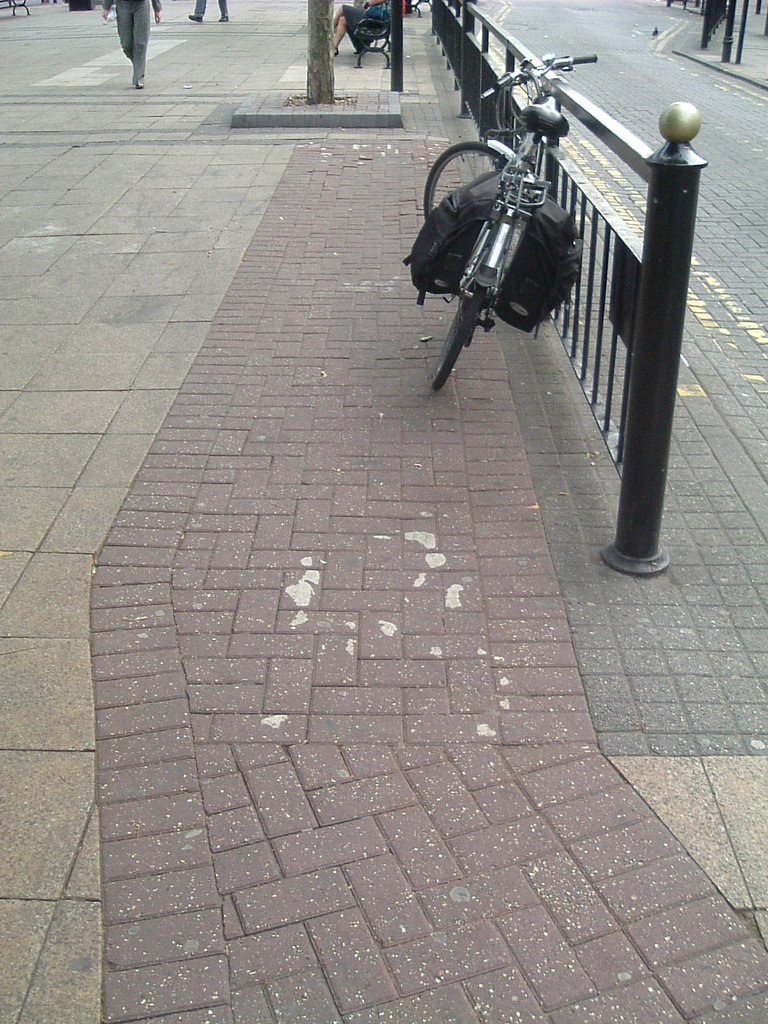
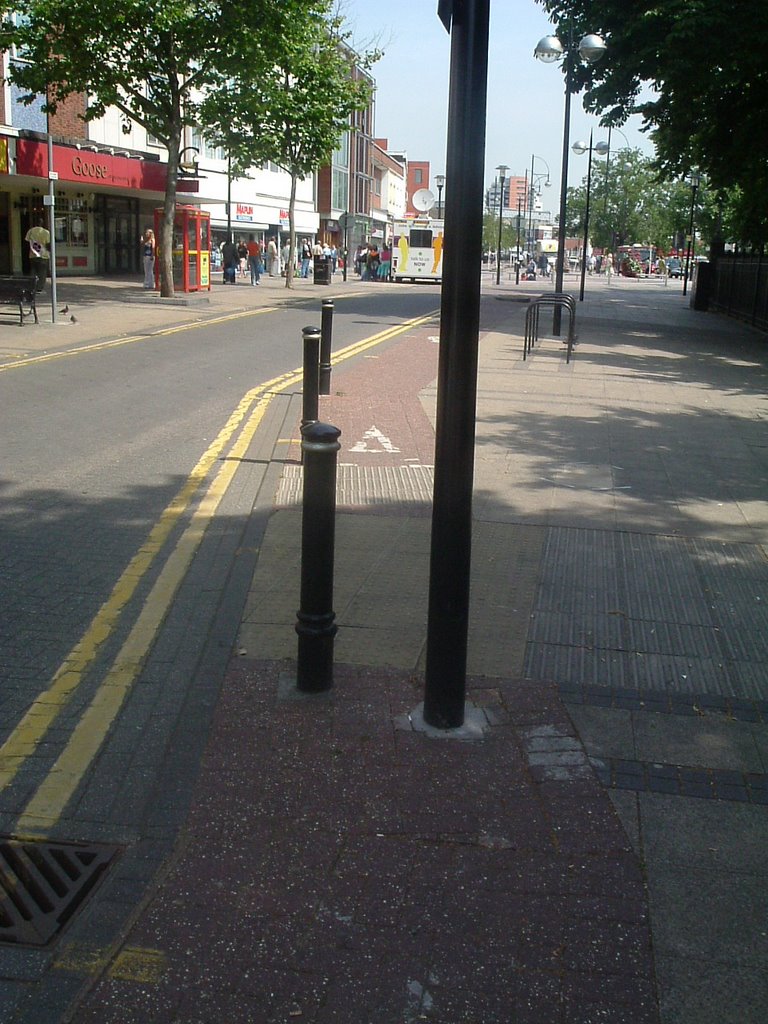
Believe it or not, this is a cycle lane. It runs through the centre of Stratford in east London. It serves as a contra-flow lane and runs past the main shopping parade. It's bizarre anyway - as it doesn

;t look anything like a cycle lane, except for the representations of cycles that used to be visible alonf its length. You can see the remains of one in this picture (left).

Most people walking along the pavement here seem entirely unaware that this is a cycle lane, and any cyclist braving the tuts of disapproval usually ends up having to give way to every pedestrians walking along this route

And this (right) is where the path just ends. WTF! Where do I go now?

I love this bit (left). Are we expected to squeeze between the poles?

Sunday, July 02, 2006

Political Intolerance in Britain

A man was arrested for distributing an article by Henry Porter in Vanity Fair. The Independent have picked it up:
People are being arrested and charged as terrorists in Britain now merely for voicing political dissent.

This is it in its entirety:

Blair's Big Brother Legacy
By HENRY PORTER
In the guise of fighting terrorism and maintaining public order, Tony Blair's government has quietly and systematically taken power from Parliament and from the British people. The author charts a nine-year assault on civil liberties that reveals the danger of trading freedom for security—and must have Churchill spinning in his grave
I.M.-ING THE P.M.: BLAIR-PORTER E-MAIL EXCHANGE
In the shadow of Winston Churchill's statue opposite the House of Commons, a rather odd ritual has developed on Sunday afternoons. A small group of people—mostly young and dressed outlandishly—hold a tea party on the grass of Parliament Square. A woman looking very much like Mary Poppins passes plates of frosted cakes and cookies, while other members of the party flourish blank placards or, as they did on the afternoon I was there, attempt a game of cricket.
Sometimes the police move in and arrest the picnickers, but on this occasion the officers stood at a distance, presumably consulting on the question of whether this was a demonstration or a non-demonstration. It is all rather silly and yet in Blair's Britain there is a kind of nobility in the amateurishness and persistence of the gesture. This collection of oddballs, looking for all the world as if they had stepped out of the Michelangelo Antonioni film Blow-Up, are challenging a new law which says that no one may demonstrate within a kilometer, or a little more than half a mile, of Parliament Square if they have not first acquired written permission from the commissioner of the Metropolitan Police. This effectively places the entire center of British government, Whitehall and Trafalgar Square, off-limits to the protesters and marchers who have traditionally brought their grievances to those in power without ever having to ask a policeman's permission.
The non-demo demo, or tea party, is a legalistic response to the law. If anything is written on the placards, or if someone makes a speech, then he or she is immediately deemed to be in breach of the law and is arrested. The device doesn't always work. After drinking tea in the square, a man named Mark Barrett was recently convicted of demonstrating. Two other protesters, Milan Rai and Maya Evans, were charged after reading out the names of dead Iraqi civilians at the Cenotaph, Britain's national war memorial, in Whitehall, a few hundred yards away.
On that dank spring afternoon I looked up at Churchill and reflected that he almost certainly would have approved of these people insisting on their right to demonstrate in front of his beloved Parliament. "If you will not fight for the right," he once growled, "when you can easily win without bloodshed, if you will not fight when your victory will be sure and not so costly, you may come to the moment when you will have to fight with all the odds against you and only a precarious chance for survival. There may be a worse case. You may have to fight when there is no chance of victory, because it is better to perish than to live as slaves."
Churchill lived in far more testing times than ours, but he always revered the ancient tradition of Britain's "unwritten constitution." I imagined him becoming flesh again and walking purposefully toward Downing Street—without security, of course—there to address Tony Blair and his aides on their sacred duty as the guardians of Britain's Parliament and the people's rights.
For Blair, that youthful baby-boomer who came to power nine years ago as the embodiment of democratic liberalism as well as the new spirit of optimism in Britain, turns out to have an authoritarian streak that respects neither those rights nor, it seems, the independence of the elected representatives in Parliament. And what is remarkable—in fact almost a historic phenomenon—is the harm his government has done to the unwritten British constitution in those nine years, without anyone really noticing, without the press objecting or the public mounting mass protests. At the inception of Cool Britannia, British democracy became subject to a silent takeover.
Last year—rather late in the day, I must admit—I started to notice trends in Blair's legislation which seemed to attack individual rights and freedoms, to favor ministers (politicians appointed by the prime minister to run departments of government) over the scrutiny of Parliament, and to put in place all the necessary laws for total surveillance of society.
There was nothing else to do but to go back and read the acts—at least 15 of them—and to write about them in my weekly column in The Observer. After about eight weeks, the prime minister privately let it be known that he was displeased at being called authoritarian by me. Very soon I found myself in the odd position of conducting a formal e-mail exchange with him on the rule of law, I sitting in my London home with nothing but Google and a stack of legislation, the prime minister in No. 10 with all the resources of government at his disposal. Incidentally, I was assured that he had taken time out of his schedule so that he himself could compose the thunderous responses calling for action against terrorism, crime, and antisocial behavior.
The day after the exchange was published, the grudging truce between the government and me was broken. Blair gave a press conference, in which he attacked media exaggeration, and the then home secretary, Charles Clarke, weighed in with a speech at the London School of Economics naming me and two other journalists and complaining about "the pernicious and even dangerous poison" in the media.
So, I guess this column comes with a health warning from the British government, but please don't pay it any mind. When governments attack the media, it is often a sign that the media have for once gotten something right. I might add that this column also comes with the more serious warning that, if rights have been eroded in the land once called "the Mother of Parliaments," it can happen in any country where a government actively promotes the fear of terrorism and crime and uses it to persuade people that they must exchange their freedom for security.
Blair's campaign against rights contained in the Rule of Law—that is, that ancient amalgam of common law, convention, and the opinion of experts, which makes up one half of the British constitution—is often well concealed. Many of the measures have been slipped through under legislation that appears to address problems the public is concerned about. For instance, the law banning people from demonstrating within one kilometer of Parliament is contained in the Serious Organised Crime and Police Act of 2005. The right to protest freely has been affected by the Terrorism Act of 2000, which allows police to stop and search people in a designated area—which can be anywhere—and by antisocial-behavior laws, which allow police to issue an order banning someone from a particular activity, waving a banner, for instance. If a person breaks that order, he or she risks a prison sentence of up to five years. Likewise, the Protection from Harassment Act of 1997—designed to combat stalkers and campaigns of intimidation—is being used to control protest. A woman who sent two e-mails to a pharmaceutical company politely asking a member of the staff not to work with a company that did testing on animals was prosecuted for "repeated conduct" in sending an e-mail twice, which the act defines as harassment.
There is a demonic versatility to Blair's laws. Kenneth Clarke, M.P. (Member of Parliament), a former Conservative chancellor of the Exchequer and home secretary, despairs at the way they are being used. "What is assured as being harmless when it is introduced gets used more and more in a way which is sometimes alarming," he says. His colleague David Davies, M.P., the Conservative shadow home secretary, is astonished by Blair's Labour Party: "If I had gone on the radio 15 years ago and said that a Labour government would limit your right to trial by jury, would limit—in some cases eradicate—habeas corpus, constrain your right of freedom of speech, they would have locked me up."
Indeed they would. But there's more, so much in fact that it is difficult to grasp the scope of the campaign against British freedoms. But here goes. The right to a jury trial is removed in complicated fraud cases and where there is a fear of jury tampering. The right not to be tried twice for the same offense—the law of double jeopardy—no longer exists. The presumption of innocence is compromised, especially in antisocial-behavior legislation, which also makes hearsay admissible as evidence. The right not to be punished unless a court decides that the law has been broken is removed in the system of control orders by which a terrorist suspect is prevented from moving about freely and using the phone and Internet, without at any stage being allowed to hear the evidence against him—house arrest in all but name.
Freedom of speech is attacked by Section Five of the Criminal Justice and Public Order Act, which preceded Blair's government, but which is now being used to patrol opinion. In Oxford last year a 21-year-old graduate of Balliol College named Sam Brown drunkenly shouted in the direction of two mounted police officers, "Mate, you know your horse is gay. I hope you don't have a problem with that." He was given one of the new, on-the-spot fines—£80, or $140—which he refused to pay, with the result that he was taken to court. Some 10 months later the Crown Prosecution Service dropped its case that he had made homophobic remarks likely to cause disorder. There are other people the police have investigated but failed to prosecute: columnist Cristina Odone, who made a barely disparaging aside about the Welsh people on TV (she referred to them as "little Welshies"); and the head of the Muslim Council of Great Britain, Sir Iqbal Sacranie, who said that homosexual practices were "not acceptable" and civil partnerships between gays were "harmful."
The remarks may be a little inappropriate, but I find myself regretting that my countrymen's opinions—their bloody-mindedness, their truculence in the face of authority, their love of insult and robust debate—are being edged out by this fussy, hairsplitting, second-guessing, politically correct state that Blair is trying to build with what he calls his "respect agenda."
Do these tiny cuts to British freedom amount to much more than a few people being told to be more considerate? Shami Chakrabarti, the petite whirlwind who runs Liberty, the British equivalent of the A.C.L.U., believes that "the small measures of increasing ferocity add up over time to a society of a completely different flavor." That is exactly the phrase I was looking for. Britain is not a police state—the fact that Tony Blair felt it necessary to answer me by e-mail proves that—but it is becoming a very different place under his rule, and all sides of the House of Commons agree. The Liberal Democrats' spokesman on human rights and civil liberties, David Heath, M.P., is skeptical about Blair's use of the terrorist threat. "The age-old technique of any authoritarian or repressive government has always been to exaggerate the terrorist threat to justify their actions," he says. "I am not one to underestimate the threat of terrorism, but I think it has been used to justify measures which have no relevance to attacking terrorism effectively." And Bob Marshall-Andrews—a Labour M.P. who, like quite a number of others on Blair's side of the House of Commons, is deeply worried about the tone of government—says of his boss, "Underneath, there is an unstable authoritarianism which has seeped into the [Labour] Party."
Chakrabarti, who once worked as a lawyer in the Home Office, explains: "If you throw live frogs into a pan of boiling water, they will sensibly jump out and save themselves. If you put them in a pan of cold water and gently apply heat until the water boils they will lie in the pan and boil to death. It's like that." In Blair you see the champion frog boiler of modern times. He is also a lawyer who suffers acute impatience with the processes of the law. In one of his e-mails to me he painted a lurid—and often true—picture of the delinquency in some of Britain's poorer areas, as well as the helplessness of the victims. His response to the problem of societal breakdown was to invent a new category of restraint called the Anti-Social Behaviour Order, or ASBO. "Please speak to the victims of this menace," he wrote.
"They are people whose lives have been turned into a daily hell. Suppose they live next door to someone whose kids are out of control: who play their music loud until 2 a.m.; who vilify anyone who asks them to stop; who are often into drugs or alcohol? Or visit a park where children can't play because of needles, used condoms, and hooligans hanging around.
"It is true that, in theory, each of these acts is a crime for which the police could prosecute. In practice, they don't. It would involve in each case a disproportionate amount of time, money and commitment for what would be, for any single act, a low-level sentence. Instead, they can now use an ASBO or a parenting order or other measures that attack not an offence but behaviour that causes harm and distress to people, and impose restrictions on the person doing it, breach of which would mean they go to prison."
How the ASBO works is that a complaint is lodged with a magistrate's court—the lowest level of court in Britain—which names an individual or parent of a child who is said to be the source of antisocial behavior. The actions which cause the trouble do not have to be illegal in themselves before an ASBO is granted and the court insists on the cessation of that behavior—which may be nothing more than walking a dog, playing music, or shouting in the street. It is important to understand that the standards of evidence are much lower here than in a normal court hearing because hearsay—that is, rumor and gossip—is admissible. If a person is found to have broken an ASBO, he or she is liable to a maximum of five years in prison, regardless of whether the act is in itself illegal. So, in effect, the person is being punished for disobedience to the state.
Blair is untroubled by the precedent that this law might offer a real live despot, or by the fact that ASBOs are being used to stifle legitimate protest, and indeed, in his exchange with me, he seemed to suggest that he was considering a kind of super-ASBO for more serious criminals to "harry, hassle and hound them until they give up or leave the country." It was significant that nowhere in this rant did he mention the process of law or a court.
He offers something new: not a police state but a controlled state, in which he seeks to alter radically the political and philosophical context of the criminal-justice system. "I believe we require a profound re-balancing of the civil-liberties debate," he said in a speech in May. "The issue is not whether we care about civil liberties but what that means in the early 21st century." He now wants legislation to limit powers of British courts to interpret the Human Rights Act. The act, imported from the European Convention on Human Rights, was originally inspired by Winston Churchill, who had suggested it as a means to entrench certain rights in Europe after the war.
Blair says that this thinking springs from the instincts of his generation, which is "hard on behaviour and soft on lifestyle." Actually, I was born six weeks before Blair, 53 years ago, and I can categorically say that he does not speak for all my generation. But I agree with his other self-description, in which he claims to be a modernizer, because he tends to deny the importance of history and tradition, particularly when it comes to Parliament, whose powers of scrutiny have suffered dreadfully under his government.
There can be few duller documents than the Civil Contingencies Act of 2004 or the Inquiries Act of 2005, which is perhaps just as well for the government, for both vastly extend the arbitrary powers of ministers while making them less answerable to Parliament. The Civil Contingencies Act, for instance, allows a minister to declare a state of emergency in which assets can be seized without compensation, courts may be set up, assemblies may be banned, and people may be moved from, or held in, particular areas, all on the belief that an emergency might be about to occur. Only after seven days does Parliament get the chance to assess the situation. If the minister is wrong, or has acted in bad faith, he cannot be punished.
One response might be to look into his actions by holding a government investigation under the Inquiries Act, but then the minister may set its terms, suppress evidence, close the hearing to the public, and terminate it without explanation. Under this act, the reports of government inquiries are presented to ministers, not, as they once were, to Parliament. This fits very well into a pattern where the executive branch demands more and more unfettered power, as does Charles Clarke's suggestion that the press should be subject to statutory regulation.
I realize that it would be testing your patience to go too deeply into the Legislative and Regulatory Reform Bill, which the government has been trying to smuggle through Parliament this year, but let me just say that its original draft would have allowed ministers to make laws without reference to elected representatives.
Imagine the president of the United States trying to neuter the Congress in this manner, so flagrantly robbing it of its power. Yet until recently all this has occurred in Britain with barely a whisper of coverage in the British media.
Blair is the lowest he has ever been in the polls, but he is still energetically fighting off his rival, Gordon Brown, with a Cabinet reshuffle and a stout defense of his record. In an e-mail to me, Blair denied that he was trying to abolish parliamentary democracy, then swiftly moved to say how out of touch the political and legal establishments were, which is perhaps the way that he justifies these actions to himself. It was striking how he got one of his own pieces of legislation wrong when discussing control orders—or house arrest—for terrorist suspects in relation to the European Convention on Human Rights, which is incorporated into British law under the Human Rights Act. "The point about the Human Rights Act," he declared, "is that it does allow the courts to strike down the act of our 'sovereign Parliament.'" As Marcel Berlins, the legal columnist of The Guardian, remarked, "It does no such thing."
How can the prime minister get such a fundamentally important principle concerning human rights so utterly wrong, especially when it so exercised both sides of the House of Commons? The answer is that he is probably not a man for detail, but Charles Moore, the former editor of The Daily Telegraph, now a columnist and the official biographer of Margaret Thatcher, believes that New Labour contains strands of rather sinister political DNA. "My theory is that the Blairites are Marxist in process, though not in ideology—well, actually it is more Leninist." It is true that several senior ministers had socialist periods. Charles Clarke, Dr. John Reid, recently anointed home secretary, and Jack Straw, the former foreign secretary, were all on the extreme left, if not self-declared Leninists. Moore's implication is that the sacred Blair project of modernizing Britain has become a kind of ersatz ideology and that this is more important to Blair than any of the country's political or legal institutions. "He's very shallow," says Moore. "He's got a few things he wants to do and he rather impressively pursues them."
One of these is the national-ID-card scheme, opposition to which brings together such disparate figures as the Earl of Onslowe, a Conservative peer of the realm; Commander George Churchill-Coleman, the famous head of New Scotland Yard's anti-terrorist unit during the worst years of I.R.A. bombings; and Neil Tennant, one half of the hugely successful pop group Pet Shop Boys.
The idea of the ID card seems sensible in the age of terrorism, identity theft, and illegal immigration until you realize that the centralized database—the National Identity Register—will log and store details of every important action in a person's life. When the ID card is swiped as someone identifies himself at, say, a bank, hospital, pharmacy, or insurance company, those details are retained and may be inspected by, among others, the police, tax authorities, customs, and M.I.5, Britain's domestic-intelligence service. The system will locate and track the entire adult population. If you put it together with the national system of license-plate-recognition cameras, which is about to go live on British highways and in town centers, and understand that the ID card, under a new regulation, will also carry details of a person's medical records, you realize that the state will be able to keep tabs on anyone it chooses and find out about the most private parts of a person's life.
Despite the cost of the ID-card system—estimated by the government as being about £5.8 billion ($10.9 billion) and by the London School of Economics as being between £10 and £19 billion ($17.2 to $35.8 billion)—few think that it will attack the problems of terrorism and ID theft. George Churchill-Coleman described it to me as an absolute waste of time. "You and I will carry them because we are upright citizens. But a terrorist isn't going to carry [his own]. He will be carrying yours."
Neil Tennant, a former Labour donor who has stopped giving money to and voting for Labour because of ID cards, says, "My specific fear is that we are going to create a society where a policeman stops me on the way to Waitrose [a supermarket] on the King's Road and says, 'Can I see your identity card?' I don't see why I should have to do that." Tennant says he may leave the country if a compulsory ID card comes into force. "We can't live in a total-surveillance society," he adds. "It is to disrespect us."
Defending myself against claims of paranoia and the attacks of Labour's former home secretary, I have simply referred people to the statute book of British law, where the evidence of what I have been saying is there for all to see. But two other factors in this silent takeover are not so visible. The first is a profound change in the relationship between the individual and the state. Nothing demonstrates the sense of the state's entitlement over the average citizen more than the new laws that came in at the beginning of the year and allow anyone to be arrested for any crime—even dropping litter. And here's the crucial point. Once a person is arrested he or she may be fingerprinted and photographed by the police and have a DNA sample removed with an oral swab—by force if necessary. And this is before that person has been found guilty of any crime, whether it be dropping litter or shooting someone.
So much for the presumption of innocence, but there again we have no reason to be surprised. Last year, in his annual Labour Party Conference speech, Blair said this: "The whole of our system starts from the proposition that its duty is to protect the innocent from being wrongly convicted. Don't misunderstand me. That must be the duty of any criminal-justice system. But surely our primary duty should be to allow law-abiding people to live in safety. It means a complete change of thinking. It doesn't mean abandoning human rights. It means deciding whose come first." The point of human rights, as Churchill noted, is that they treat the innocent, the suspect, and the convict equally: "These are the symbols, in the treatment of crime and criminals, which mark and measure the stored-up strength of a nation, and are a sign and proof of the living virtue in it."
The DNA database is part of this presumption of guilt. Naturally the police support it, because it has obvious benefits in solving crimes, but it should be pointed out to any country considering the compulsory retention of the DNA of innocent people that in Britain 38 percent of all black men are represented on the database, while just 10 percent of white men are. There will be an inbuilt racism in the system until—heaven forbid—we all have our DNA taken and recorded on our ID cards.
Baroness Kennedy, a lawyer and Labour peer, is one of the most vocal critics of Blair's new laws. In the annual James Cameron Memorial Lecture at the City University, London, this April she gave a devastating account of her own party's waywardness. She accused government ministers of seeing themselves as the embodiment of the state, rather than, as I would put it, the servants of the state.
"The common law is built on moral wisdom," she said, "grounded in the experience of ages, acknowledging that governments can abuse power and when a person is on trial the burden of proof must be on the state and no one's liberty should be removed without evidence of the highest standard. By removing trial by jury and seeking to detain people on civil 'ASBO' orders as a pre-emptive strike, by introducing ID cards, the government is creating new paradigms of state power. Being required to produce your papers to show who you are is a public manifestation of who is in control. What we seem to have forgotten is that the state is there courtesy of us and we are not here courtesy the state."
The second invisible change that has occurred in Britain is best expressed by Simon Davies, a fellow at the London School of Economics, who did pioneering work on the ID-card scheme and then suffered a wounding onslaught from the government when it did not agree with his findings. The worrying thing, he suggests, is that the instinctive sense of personal liberty has been lost in the British people. "We have reached that stage now where we have gone almost as far as it is possible to go in establishing the infrastructures of control and surveillance within an open and free environment," he says. "That architecture only has to work and the citizens only have to become compliant for the government to have control. That compliance is what scares me the most. People are resigned to their fate. They've bought the government's arguments for the public good. There is a generational failure of memory about individual rights. Whenever government says that some intrusion is necessary in the public interest, an entire generation has no clue how to respond, not even intuitively And that is the great lesson that other countries must learn. The U.S. must never lose sight of its traditions of individual freedom."
Those who understand what has gone on in Britain have the sense of being in one of those nightmares where you are crying out to warn someone of impending danger, but they cannot hear you. And yet I do take some hope from the picnickers of Parliament Square. May the numbers of these young eccentrics swell and swell over the coming months, for their actions are a sign that the spirit of liberty and dogged defiance are not yet dead in Britain.
Henry Porter is Vanity Fair's London editor. His books include Brandenburg Gate (Atlantic Monthly Press), Empire State (Orion), and A Spy's Life (Orion).
Illustrations by TIM SHEAFFER
Saturday, July 01, 2006

Critical Mass

It was celebratory; not a bit like the angry confrontational rides we took part in through the winter. I met S. at 7.00 by the NFT. It was fun, and the weather was good, but I was struggling by the end: dehydrated, tired, hungry. We peeled off at about 9.30 to get an Indian takeaway, a couple of beers, and to go home.
 
I took some pictures; and they will appear on here at some point.
 
Feeling a bit hungover, tired, unwashed and dazed. S ended up in a row with the laundress so we've got no clean clothes to put on, although I'm hoping to put that right at some point today or first thing tomorrow.
 
I rewatched "Dig!" last night. It made me want to find out more about the Brian Jonestown Experience, and confirmed my hatred of the Dandy Warhols. Lightweight exploitative tossers that they are! The bit that made me really angry was when the Dandys went round to the BJM's house for a photoshoot, so that they could look more credible being photographed in a house full of junkies!
 
Watered the plants this morning, and let the cats out for a little walk round the balcony, sniffing everything.
 
DSCF0110.jpg
 
DSCF0116.jpg
 
DSCF0094.jpg


FW: Critical Mass

It was celebratory; not a bit like the angry confrontational rides we took part in through the winter. I met S. at 7.00 by the NFT. It was fun, and the weather was good, but I was struggling by the end: dehydrated, tired, hungry. We peeled off at about 9.30 to get an Indian takeaway, a couple of beers, and to go home.

I took some pictures; and they will appear on here at some point.

Feeling a bit hungover, tired, unwashed and dazed. S ended up in a row with the laundress so we've got no clean clothes to put on, although I'm hoping to put that right at some point today or first thing tomorrow.

I rewatched "Dig!" last night. It made me want to find out more about the Brian Jonestown Experience, and confirmed my hatred of the Dandy Warhols. Lightweight exploitative tossers that they are! The bit that made me really angry was when the Dandys went round to the BJM's house for a photoshoot, so that they could look more credible being photographed in a house full of junkies!

Watered the plants this morning, and let the cats out for a little walk round the balcony, sniffing everything.

DSCF0116.jpg


Friday, June 30, 2006

I Saw A Stag Beetle Yesterday


It was on the pavement by woolwich Common.

After I took the photograph I moved it into the foliage where it wouldn;t end up getting squashed or picked off by a bird.

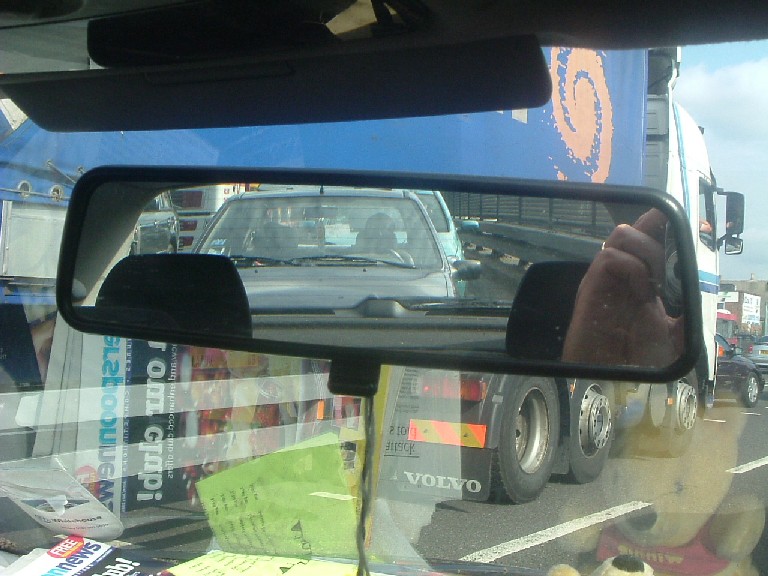
Stuck In a Traffic Jam


DSCF0029small.jpg


You can see two permanent residents in our car here - the cat S bought at Chinese New Year's and the Winnie the Pooh that I got free with soem stuff once - about 16 years ago.

after the Shepherd Neame lorry passed me all I could think of was the nice chilled beer I could have once I got home. I didn;t realise at this point I had another two hours before I managed this.

Critical Mass isn't illegal

http://news.bbc.co.uk/1/hi/england/london/5119826.stm

Very good news and I shall be on tonights CM.
I'm gonna stick some names on here now, in case any of these people decide to google for their own name, and they'll get my blog up. This page in fact. Bill or Will sheward, Andy or Andrew Willis, Ed or Edward Millar, Dave Murrill. Dave - give me a ring!
Hi guys- I'm sure you can work out who I am - keep in touch!

A Short One

I've emailed this in - just to see if it works.
 
Heart FM - anyone listen this heap of shit disguised a sa radio station?
 
How many times does anyone want to listen to "Dock of the Fucking Bay" and "Heard It Through The Sodding Grapevine"?

Thursday, June 29, 2006

I had the car last night - I'm laying off the cycling a little until the Dunwich Dynamo next week. I came off the motorway coming out of the Blackwall Tunnel last night, and tootled round the Greenwich peninsula for a little bit. There's not much to see, lots of building sites, an eco friendly Sainsbury's, and the Dome looming over it all. It's all set out in wide tree lined avenues, like its some sun-soaked coastal community on the Med.

Then I got bored and headed home, via Chislehurst High Street. Half price duck in the chiller, and I couldn't resist. The girl on the check out engaged me in conversation - "what's duck taste like?", "Do you feel funny eating duck when you can see them swimming around?", "Is it for a special occasion?".

I spent the evening putting tracks on my MP3 player - an album by The Coral, Polyphonic Spree's first one, an early Pulp cd, and the Scissor Sisters.

Just gearing up to putting some Beatles on there. I was spurred on by certain fuckwitted and immature anti-beatles posturing on Urban 75 yesterday to listen to the White Album again. It sounded better than I expected, with a few stand-out tracks - Dear Prudence, Wild Honey Pie, Me and My Monkey.

I've got the cats living with me now - and on Wednesdays when my daughter is visiting her Grandmother just a few doors along from my house, I take the female cat along so they can have quality time together. Then, at about 10.00, the cat is brought home again. She's usually a bit overexcited by this time, and runs around the house making meeping noises.

When I water the plants on the balcony, the male cat mews pathetically at me:


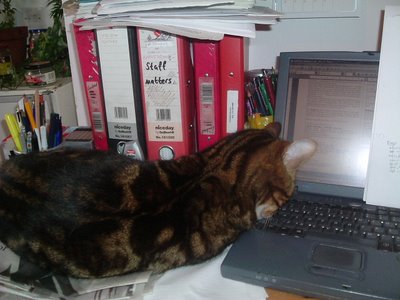
When I try to work on my laptop - he does this:

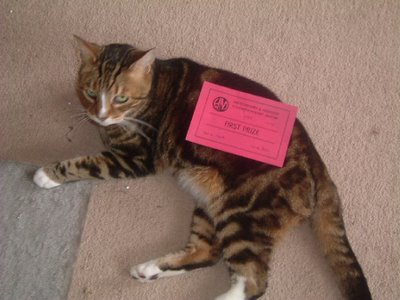
So I take the piss out of him sometimes - here I am honouring him by photographing him with the certificate he won at a cat show once:

There was John Cale special on 6Music this morning. I've got a little bit by him, but I realise I need to get more.

I'm no longer the only cyclist in the depot. I saw some other bugger had his bike locked up in the yard the other day.

I finally gave in to the nagging and saw a doctor the other day. I'm completely healthy apparently. So if I feel shit all the time, it's my own bloody fault.

Tuesday, June 06, 2006


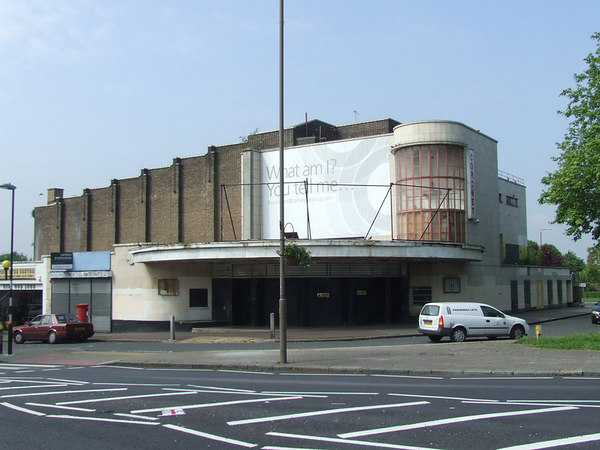
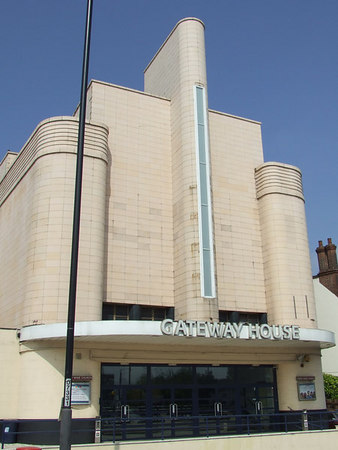
I stopped to take a photo of the long-abandoned and derelict Eltham Coronet. A friend from my Thames Poly days used to go see films here back in the '80s and S. was in here quite a lot too, years before we actually met for the first time, watching late night horror film screenings.

It's a damned shame that no-one can find a use for it now though. Even more of a pity that it can't be reopened as a cinema - it'd be ideal for people in my area who can't be arsed traipsing all the way into the West End to see a film, plus local cinemas always showed stuff that the big central cinemas just can't afford to show - old sci fi and horror classics.
Though looking at what happened to the Woolwich Coronet, I guess there are fates worse than death for old cinemas.

The Woolwich Coronet is now some dodgy American Evangalist church. I used to see bands, and cheap Wednesday matinee performances of the latest Hollwywood releases there.

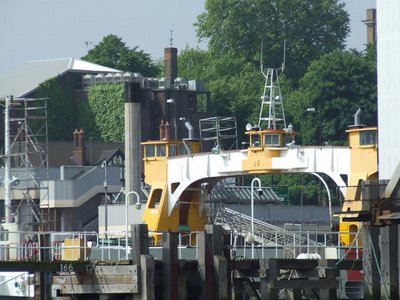
And of course - the inevitable Woolwich Ferry pictures; I can't resist.


More cycling related fuckwittery


If in doubt - park in the cycle lane - even if it
means you have to mount the pavement.


yes of course it does.

Monday, June 05, 2006

Exclusive pictures of Heron Eating Eel!!


Pub fire in Eltham

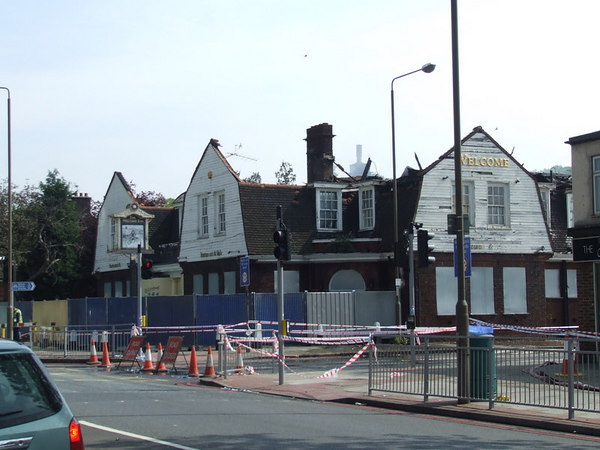
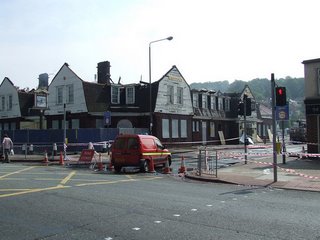
I was cycling through Eltham the other day and noticed that this pub - which has been derelict for years - has finally burnt down.

Which is handy for whoever owns it - as they will now find it so much much easier to gain planning permission to build luxury housing on this site.


On the left - detail - you can see smoke still rising from the inside of the building.


Wednesday, February 15, 2006

I’ve been ill. After xmas I came down with some sort of nasty flu thing which sapped my strength. What was worse – I’d already booked every Wednesday in January as leave, to use last year’s leave up. I thought I’d be able to use those days as a cycling opportunity. In the end I was glad to have the day off on the 4th to lay around in bed. As I recovered – I managed a short ride into Kent, followed by a longer one – all the way to Sevenoaks. Then I was worse again and laid around all day. I’m just getting my voice back – the ears still hurt – and if I spend too long in the cold my throat goes again, and I can hardly speak.

I have bought an MP3 player though. I’ve stuffed it with about 300 songs so far – Joy Division, Elvis Costello’s “Useless Beauty”, Placebo singles, some Bjork, The Rutles, History of Hip-Hop, a jazz compilation, ELO Greatest Hits, Iggy Pop, Glen Campbell, Lou Reed, Velvet Underground etc.

I’m embarking on a mission to digitise all my vinyl and cassettes. It’ll probably take a few years.

Went out with S. last night to celebrate Valentine’s Day with a slap up feast in a Polish restaurant. I had Hunter’s Stew, a massive quarter of duck, veggie side dishes, a slab of cheesecake, and flavoured vodka.

Watched the UK version of police, camera, action, which was complete wank. Idiots were theorising about the future of the motor-car – one plonker said it was turning into an “information platform”, and others claimed that the self driving car was nigh – except that it could never cope with the unexpected – like an animal running out in front of it. What will they do? Put up huge fences to keep us all off the public highway? Ban cyclists and pedestrians? Probably.

Which brings me back my favourite anti-establishment rant. ID cards are coming – compulsory cards now two years away. I’ll try to restrain myself from running off on this subject – for now.

Olympics – I’m in two minds about this scheme
http://news.bbc.co.uk/1/hi/england/london/4712904.stm
which seems to have split the cycling activists. Sustrans are proposing it but the resources needed will almost certainly have massive impact on all other cycling related projects up till 2012. And since Sustrans have failed to discuss this with anyone else, LCC and CTC have naturally been cautious, or even sceptical, regarding this scheme. It’s a nice idea – especially the bridge at Rotherhithe – but if its that versus every other scheme intended to help commuter cyclists on the road, and schemes to improve road safety, then I’d have to decline.

Anyway - bye for now...